Warm wet December

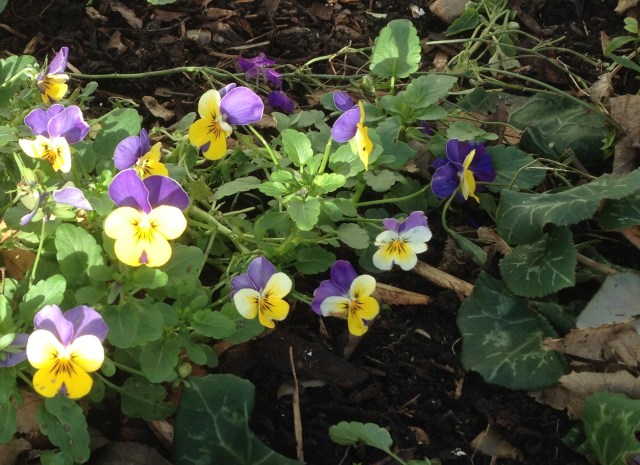
pansies in tree pits 12.15It has been remarkably warm this December. We’ve only rarely hit single figures apart from a brief overnight frost back in November. But it has been wet … very, very wet. And wet’s not good for getting out and about.

Despite that, we managed a session last Tuesday December 1st at the station – the latest we’ve ever continued into the winter. Marlene and I cleared leaves and rowan berries from the station forecourt, removed the sad bits of cyclamen and the summer’s lobelia from the platform planters, and put in some more pansies and primula in the shadier tree pit. But wet and dark, even if it is warm, really is not at all motivating. Winter’s not meant for gardening, though I tell myself pansies, primula and cyclamen will brighten things up. I still have several waiting to be planted up into my winter window boxes but still haven’t got around to it …

There’s a hint today of blue sky out there but I shan’t be venturing out into the sodden garden as I recover from a wet winter bug.  Next week, we’ll have our LRSP Xmas tea, a spur to plant up those bright flowers and get the gardens cleared.

Posted in Uncategorized | Leave a comment

Treating the trees and lulling the children

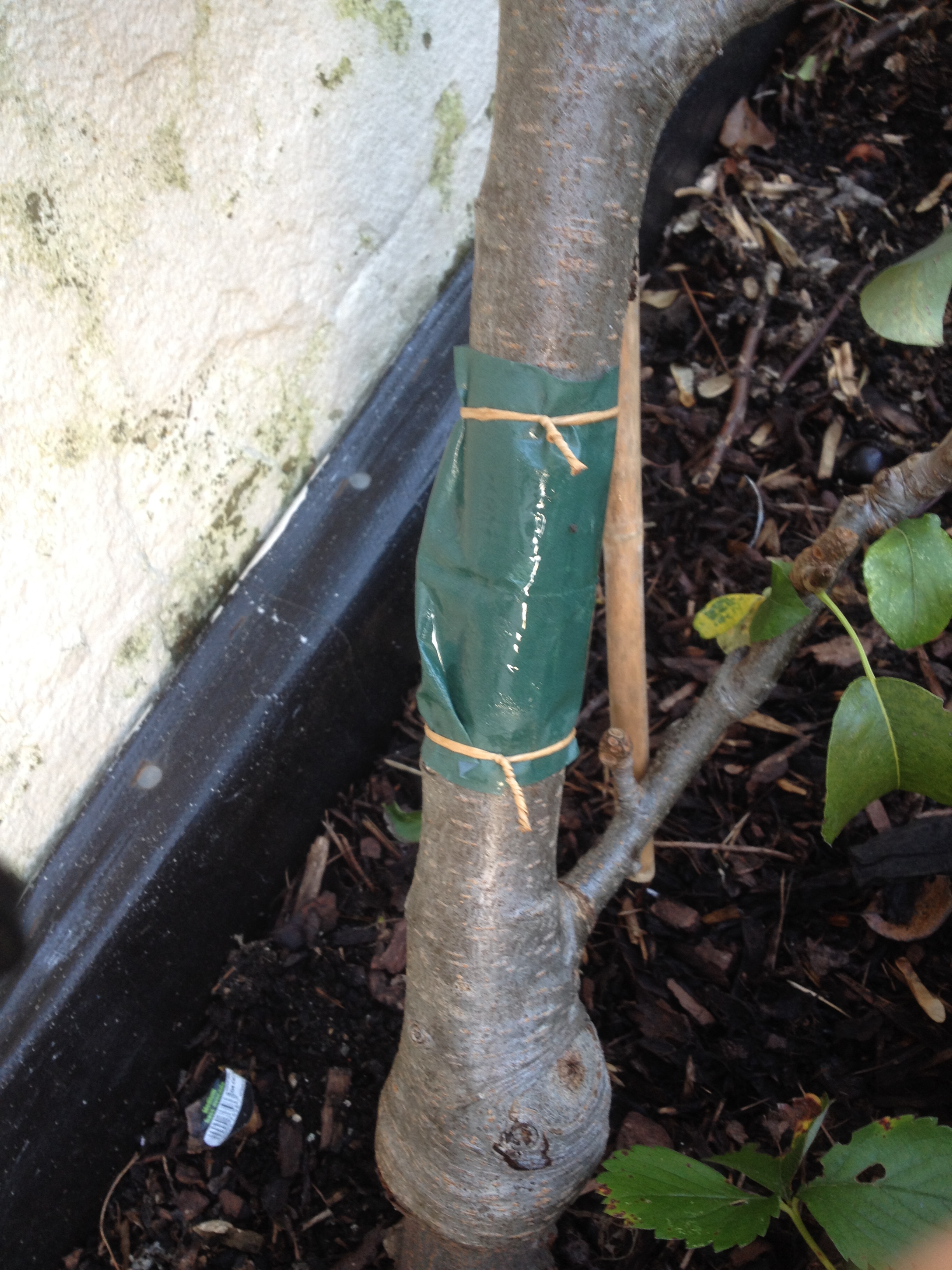
IMG_4408It should have been an easy mechanical fix: attaching grease bands around the bottom of the trunks of our fruit trees. These are supposed to trap winter moth caterpillars and maybe also ants which ‘farm’ the aphids which have so badly infested our mini-orchard these last two years.

I used pre-greased bands, basically a sticky strip that you open out and wrap around the trunk. Simple … except the sticky stuff stuck to my fingers, then to the wrong bit of the tree, then to the scissors I was using to cut the band, and finally to the bands themselves (like micro-wrestling with Sellotape, only worse). You need to bind the bands around tightly so the beasties don’t just sneak underneath, but tree trunks have bumps and crevices to get in the way. I was doing this with cold, sticky fingers on a very windy day: you can imagine …

I have the funny feeling that the final score will be: ants and moths 1  human ingenuity 0, but at least any success on my part should be visible in the form of squished ants and moths stuck on this infuriating glue. Satisfying … if it works.

I explained the principles of this to one of our regular young visitors on her way home from the local primary school, but she had no sympathy for my difficulties: “That’s SO cruel to ants!” Rather indignantly I pointed out that ants enslave aphids to suck juices from the leaves so that they (sneaky old ants) can get the honeydew secreted by the aphids. “Yes”, said a passing dad, warming to the theme, “they even dismember ladybirds which might otherwise eat the aphids. And they eat the legs, dissolving them in acid.” By this time,  several other children were staring in horrified disbelief and I felt it best to move on to the topic of winter washing.

In my best teacherly voice, I explained that I’d just sprayed the trees: “trees can’t wash, so before they go to sleep in the winter, and we have to wash them down, so they’re clear of insects”. I showed them the sprayer. They were intrigued and successfully distracted. No trapping, no melting of limbs … they were ready to sing the trees a lullaby. But then they asked what was in the ‘Winter Wash’. I said I thought it was seaweed.

I’ve just checked on the RHS site: it’s concentrated plant oils … so far so good … which “block the breathing pores of small insects and mites”. Oh dear: so basically … winter washes are about suffocating ants and aphids. I think I’ll stick with the seaweed explanation.

For those who want them, here are the gory details of looking after fruit trees :

Autumn treatment

Spring treatment

Summer treatment

  • Inspect trees for aphids and ants
  • Squish aphids and ants between thumb and index finger
  • Spray with soapy solution or organic  pyrethrum spray
  • Foliar feed
  • Replace grease bands

A good site for natural solutions to aphids on fruit trees is Natural Living Ideas but the most comprehensive ‘no-holes-barred’ presentation of pests and diseases on fruit trees is http://www.fruitwise.net/pestsanddiseases.html . It might need a ‘parental guidance’ warning, though. Here’s a flavour: “Companion planting, biodynamics or singing to the trees does no good-if you have rosy apple aphids, death is the answer-kill them all”.


Posted in Edible growing, Pests and diseases, Uncategorized | Leave a comment

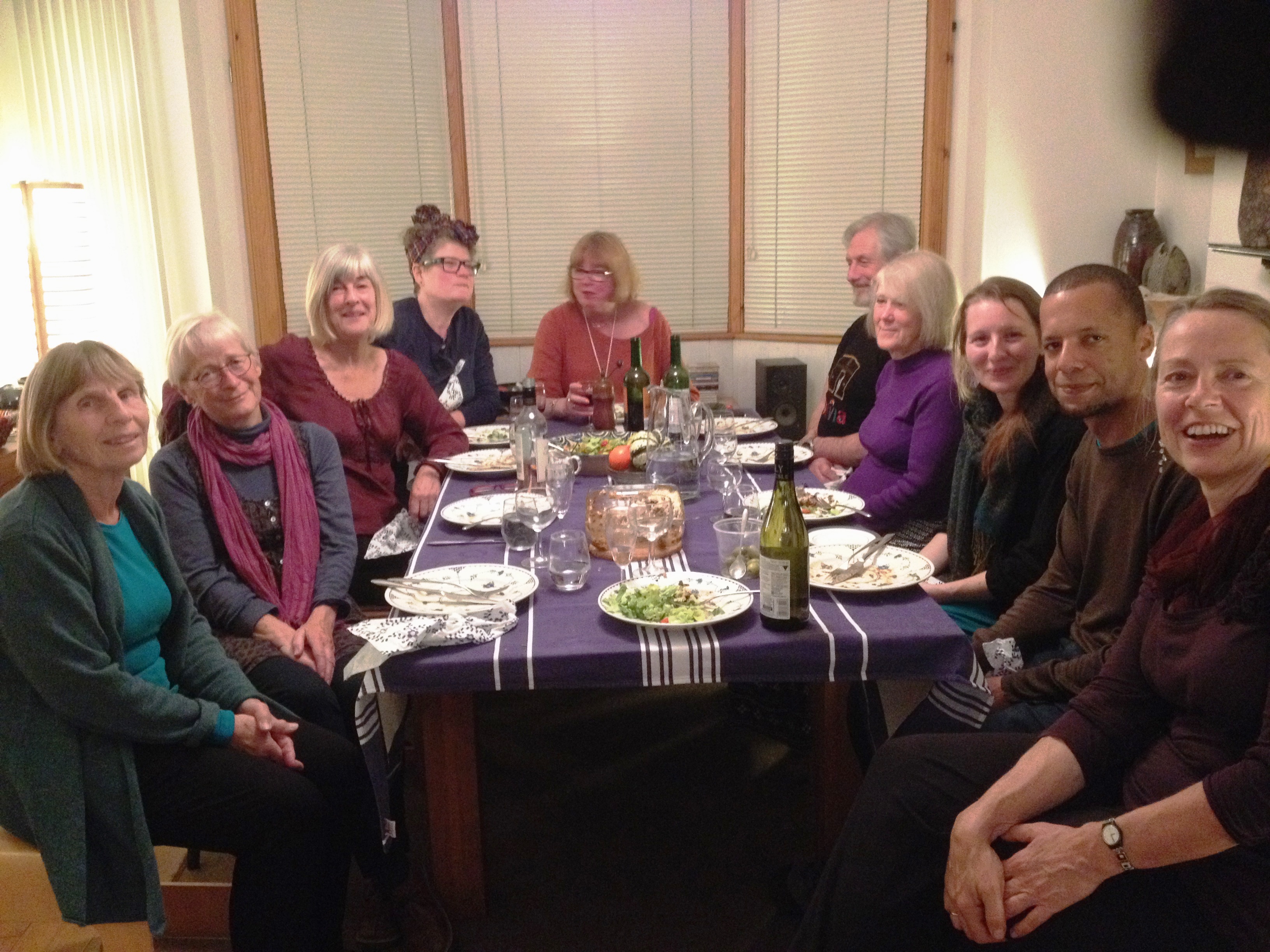
Harvest supper 2015

IMG_3948Our fifth harvest supper! Like last year, our harvest was relatively early and much of our produce was finished by the end of September. But this year we did have leeks – funny little green wisps in March, huge fat stems by September.

We started with two great leek soups: a smooth leek and potato soup followed by a spicy leek and sweet corn soup. We would have used the sweet corn from the garden, but that was finished by early September. Then a tasty vegetarian moussaka, made using our courgettes rather than aubergines, a salad of home grown tomatoes and lettuce and to finish, a lovely pear and apple crumble with our wonderfully aromatic fruit and a verbena water ice. Again Chris’ pinwheel wholemeal bread with a filling of basil (from the garden of course) and cheese was a delicious accompaniment.

Sweet corn and leeks – two things we tried this year for the first time and which were really successful. Our raspberries weren’t great this year – they probably got too dry – and the tomatoes outside in the station garden just didn’t ripen, though the greenhouse tomatoes were good. Courgettes were OK, but they went spongy pretty quickly. Pears were very good, but the apples and plums were a little disappointing: maybe it was the aphids. No two years have been the same …


Posted in Uncategorized | 1 Comment

National Community Rail Awards 2015

IMG_3939 IMG_3945

P1030002 P1030012

We were delighted that London Road Station’s underpass mosaic was nominated for a national Community Rail Award in the ‘working with young people’ category. As nobody from Albion in the Community could attend, I went along to the Association of Community Rail Partnerships (ACoRP) award ceremony in Torquay to represent London Road Station. The weather was glorious, and the train journey from Exeter to Torquay down the River Exe along the coast at Dawlish and then alongside the River Teigne has got to be one of the most beautiful in the country.

As things turned out, the mosaic project didn’t win an award, but other Southern stations did: Purley got second prize for its mural, Hassocks came second in the most enhanced station buildings category and Southern Railway got third prize for its ‘This is Me’ campaign highlighting passengers’ individual needs.

P1030019As part of the evening, we were given some very silly things to do such as standing up with hands on heads (heads) or hands on hips (tails), waiting to be eliminated as our master of ceremonies flipped a coin. Only … I wasn’t eliminated and much to my surprise, ended up on stage winning the game. The bottle of Bollinger was perfect for the next day’s LRSP Harvest Supper and the iPad mini is great for taking garden pictures and updating the blog. It was a lovely evening, spent in great company with others working to enhance stations and bring them back to being focal points in the community – lots of inspiring projects. You can read about the winning ones here.

Thanks to Vanessa Cumber and others for the photos.

Posted in Uncategorized | 1 Comment

BH Food Partnership video (featuring LRSP)

We are great fans of BH Food Partnership – they’ve supported us from the beginning, when the garden was created in 2011 and indeed before that when we had an extraordinary street party in Ditchling Rise when we covered Shaftesbury Place with vegetable seedlings which neighbours could take away.

So we’re really pleased to feature in their latest video: well done to all who have worked with BHFP and thank you for the great work you’ve undertaken. It makes a difference!

Posted in Uncategorized | 1 Comment

Checking our soil

IMG_3874We’ve cleared the remains of beans and sweet corn in the central raised bed. They seemed to have got very scrappy and didn’t grow brilliantly. Before we do any more planting, I decided to check the ph of the soil.

We are used to very alkaline soil down here near the South Downs and chalky cliffs. Surprisingly, therefore, our soil is rather on the acid side at 5.2. But it’s soil in our raised beds, rather than directly on the ground.

This is too acid to be optimum for most vegetables which like soil to be between 6-7. As an Australian site puts it: “Plant growth and most soil processes, including nutrient availability and microbial activity, are favoured by a soil pH range of 5.5 – 8. Acid soil, particularly in the subsurface, will also restrict root access to water and nutrients.”

I suspect this acidity has built up because we have put a lot of our compost into the soil – maybe too much. We like to think that organic material feeds the soil, but we may have got the balance wrong. We also used a fair amount of manure at the beginning – and we’ve incorporated Growmore at various points.

The obvious solution is to add lime: it seems so odd, since I am constantly dealing with too much alkalinity in my own garden. But it may be that with a summer of drought and deluge, the soil in our raised beds has just leached elements which would have kept the balance.

I’m going to monitor it – so that we can gradually adjust the composition of our soil ready for the next growing season. Useful websites on soil acidity can be found here and here

Posted in Uncategorized | Leave a comment

LRB Mosaic up for national award

OLYMPUS DIGITAL CAMERA OLYMPUS DIGITAL CAMERA

In August last year, a team of 12 16 year olds from a National Citizen Service scheme led by Albion in the Community were creating a wonderful mural in the underpass at London Road Station.

At the time, the team were uncertain they would ever finish the artwork in time, let alone whether it would last … but it has, and it’s a great addition to our station. And this year, their mosaic has won national recognition. It’s up for a national station award from the Association of Community Rail Partnerships. This is huge credit to the young people involved, to their belief and their energy – and to the massive commitment of their team leader, Ami.

We’re delighted, and wish you all the best at the ACoRP national award ceremony in Torquay.

Meanwhile, we’ll be attending Brighton & Hove’s City in Bloom award ceremony on 22nd September: we’ve been shortlisted again in the Best Community Garden category and have entered for the Edward Furey Cup which recognises community spirit … which leads me to reflect on the fun we’ve had, and continue to have, in the station partnership and on all the wonderful people who’ve contributed in all kinds of different ways to our gardens and events at London Road Station. That’s community spirit! Thank-you!

Posted in Uncategorized | Leave a comment

Propagating, the video

Last week we had a great time propagating at the station (hmm, perhaps a comment more worthy of London Road Station’s slightly naughty alter ego @LRBstation).

It’s a great way to ensure a stock of plants for the next season because it’s free. We’ve done it before, but this time, we’ve recorded our demonstration of propagating techniques – probably the first time it’s ever been done at the station! See below for the video.

Softwood cuttings – for tender perennials and shrubs

  1. First, get your sprigs from the ‘mother’ plant. Choose – preferably – a non-flowering healthy-looking shoot of around 8-10cm. Cut above a leaf node so that the ‘mother’ plant grows on happily.
  2. Prepare your cuttings. Cut just beneath a leaf node because this is where the growing hormones are concentrated. Remove any lower leaves which might rot as the plantlet tries to establish itself. Place cutting in a pot of water while you prepare potting compost and hormone rooting powder.
  3. Prepare pots of compost. Fill 9cm or 7cm pots with either sowing and potting compost or multipurpose compost mixed with perlite/vermiculite. Make three holes around the edge of the pot – ‘dibbing‘ – to stick the cuttings in.
  4. Dip in hormone rooting powder and plant. Dip the end of the wet cutting in the powder and shake off any excess. Stick the cutting in the hole and pat compost around it.
  5. Water with a fine rose – just enough to get the compost moist and bring the compost around the cutting.
  6. Place in propagator. Now seal the pots in a propagator with the lid on to preserve the moisture and place out of direct sunlight in a warm place such as a greenhouse. You can cover pots with plastic bags, it’s the same principle.
  7. Wait –  it’s a good idea to ventilate the plantlets from time to time by lifting off the propagator lid for 10 minutes or so at least twice a week. This is to stop them rotting but you also need to conserve moisture to stop them shrivelling up. When the plantlets start to look happy, you can increase ventilation or remove the lid altogether. My cuttings have often had to survive out of the propagator in a cold greenhouse or even outside.
  8. Look for signs of growth: new bright green buds and leaves at the top, white roots at the bottom of the pot. Getting a good root system established can take between 6-10 weeks. When it’s clear that the plantlets are growing, you can pot on – i.e. remove the three rooted plantlets from their collective home and give each one an individual pot to grow on …
Posted in Video | 1 Comment

Summertime … and the pruning is easy?

I took the plunge and summer pruned our cordoned fruit trees last week. They were looking very leafy and rather unruly – but then I feel plants should be allowed some independence. Which is probably why I’ve put it off for a while. Pruning is a bit like being taken to the vet – they don’t like it, but it’s good for them. The trees were showing some lovely fruit, and fruiting requires huge energy so cutting back leafy unproductive growth should be a help not a hindrance.

It’s just that the fruit trees in our care – the station garden mini-orchard cordons of apples and pears, our plum and my own miniature apple, plums and cherries – refuse to grow like in the gardening books. The books show well-behaved trees (the kind that don’t miaouw and scratch the vet) growing at the proper angle with a satisfying, well-proportioned shape.

And there are the little red bits which show where the perfect, well-positioned cut should take place. There’s a nice clear leader and well-balanced laterals (side branches) with perfectly placed leaves: find the lateral, up 3-5 leaves and snip! Easy – only I think we’ve got sub-laterals of sub-laterals of laterals, and should the snip be on an upward or a downward facing bud?

Through trial and error (and so far our three-year-old trees haven’t given up – on the contrary), I feel like we’re getting the hang of it. Principles are good when practice isn’t like the diagram – so here we go:

  1. summer pruning is key to helping the tree concentrate on producing fruit: some advice is to prune plums after fruiting, others say prune in ‘early summer’, others in late July and for ‘trained trees’ (also read, ‘restricted’ or ‘miniature’), BBC Gardening gives ‘late August’ – so round about now is probably OK?
  2. winter pruning (February?) is about maintaining the structure of the tree; do not prune plums or cherries in the winter because of the risk of infection
  3. plums, cherries, apples and pears fruit on old wood (2-3 years old), not on the new growth – phew, ‘cos I’ve been reining in the springy adolescent shoots
  4. first cut the three ‘D’s: diseased, damaged or dying branches – or any which cross others too close
  5. buds grow at different angles: always cut to a bud going in the direction you want the new shoot – and apparently, horizontal branches fruit better than vertical (hence ‘festooning‘ or tying branches down towards the ground).
  6. according to The Telegraph, “shorten leaders by 6in” and “cut the side shoots (or laterals) to 3 leaves and any sub laterals (secondary shoots from the laterals) to 1 leaf“. The BBC says more or less the same (though the leader cut is given as after ‘two buds of new growth’ but I bet you that’s around 6 inches) – yippee!

Wow, that’s simple, but that’s going to mean an awful lot of pruning. I think some of our ‘laterals’ need to be considered ‘leaders’, so does that elevate ‘sub-laterals’ to ‘laterals’? And then there’s the problem of which way the new growth should go: a bit like cutting hair, it needs a good eye and an experienced hand manipulating super-sharp scissors. Oh dear!

Posted in Pruning | 1 Comment

Kindness, madness, carelessness, drought

Squirrels don’t plant sunflowers, I thought to myself as I watered the shady garden this evening. So how did a drooping mini-sunflower come to be sitting in one of our ceramic planters? Well, it’s August – there are mad humans about the station and yes, this weekend, for once, the minor vandalism was human in origin, not attributable to the usual delinquent squirrels.

Two of our newly planted fuchsias in the platform planters have been sat on, some of their stems broken. Inevitable, I suppose, when the planters are at seat height and there are few seats on the platforms. I’ve come over all school-marm-ish and asked people waiting to please not sit on the plants. The response that makes me smile is ‘Oh but I’m only sitting on the wood’. It almost seems like people believe the plants aren’t really there.

But the oddest human intervention this weekend wasn’t careless – quite the contrary – just rather mad. On Saturday night, someone had scrambled into the shady plot, dug a hole in one of the ceramic planters, planted a miniature sunflower, taken the trouble to water it from the water butt using the watering can and chalked on the wall: ‘D + Richie’ with a tree and an arrow pointing to the sunflower.

It was really rather touching – but sadly misguided as the ceramic planter is in deep shade, not at all what sunflowers like. And also sadly, ‘D + Richie’ had managed to uproot two small heucheras from the planter. But all is not lost: I want you to know, D + Richie, that your sunflower has been repotted and is now recovering in my greenhouse. The heucheras have also been repotted and should grow back. And we’ll plant your sunflower in the tree pit where it should enjoy the full sun. Do come back and admire it some time.

Also to appear in the tree pit is a special French marigold, the one with bright jester strips, this time the result of kindness. This is a gift from Miranda @MirandasPlants, who sells beautiful plants at nearby Florence Road Market. She stopped by the garden last year to pick up some seeds from a flower we had growing. In return, this season, she’s donated this pretty marigold which will sway in the wind with our nicotanias and cosmos.

Meanwhile, the water butts have run dry again. It’s been a glorious three days with temperatures here in the mid-twenties, but we’ve had no rain this last week and the soil is parched.  In this dry weather at this point in the season, our fruit trees need 20 litres each a week – and there are seven of them. That’s 140 litres just for the mini-orchard alone. We have water butts storing around 500 litres – probably what we require for a weekly watering. I was counting on downpours this Tuesday but the forecast has changed. Fingers crossed it rains tomorrow.


Posted in Uncategorized | 1 Comment