The irony of neglect

Image2698It keeps happening: just as I am trying to nurture a new plant, nature laughs in my face and produces a fine specimen in a neglected area. It’s actually quite reassuring – it puts us in our place.

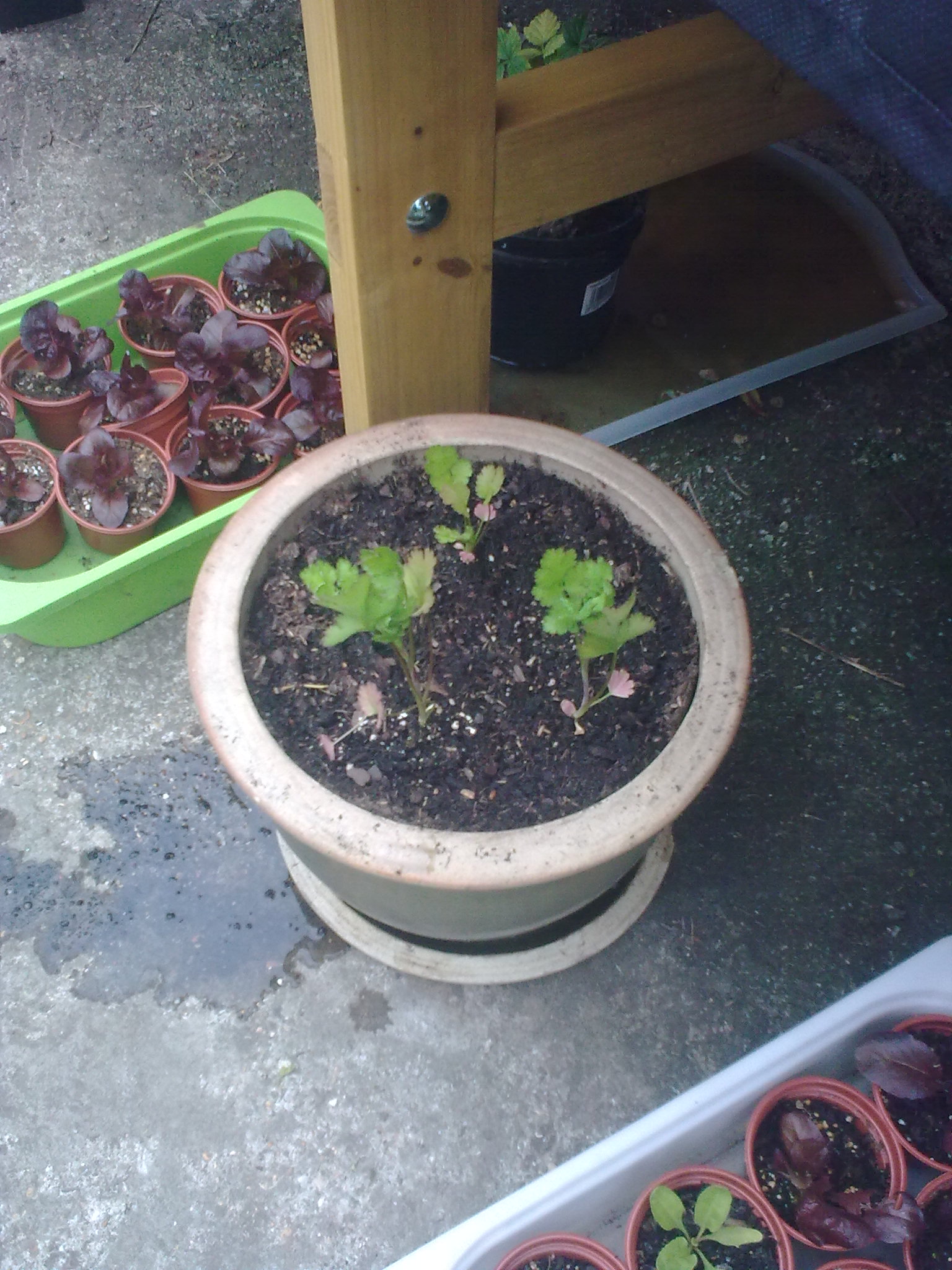
It happened yesterday. We have been trying to grow coriander as many of us love this herb. We succeeded in germinating seeds and our seedlings have slowly grown. I potted on the largest at the weekend, having carefully researched the required growing conditions for coriander: deep pot, rich soil, some shade, not too wet. The three seedlings still look rather weedy. The other seedlings in 8cm pots have stopped growing.

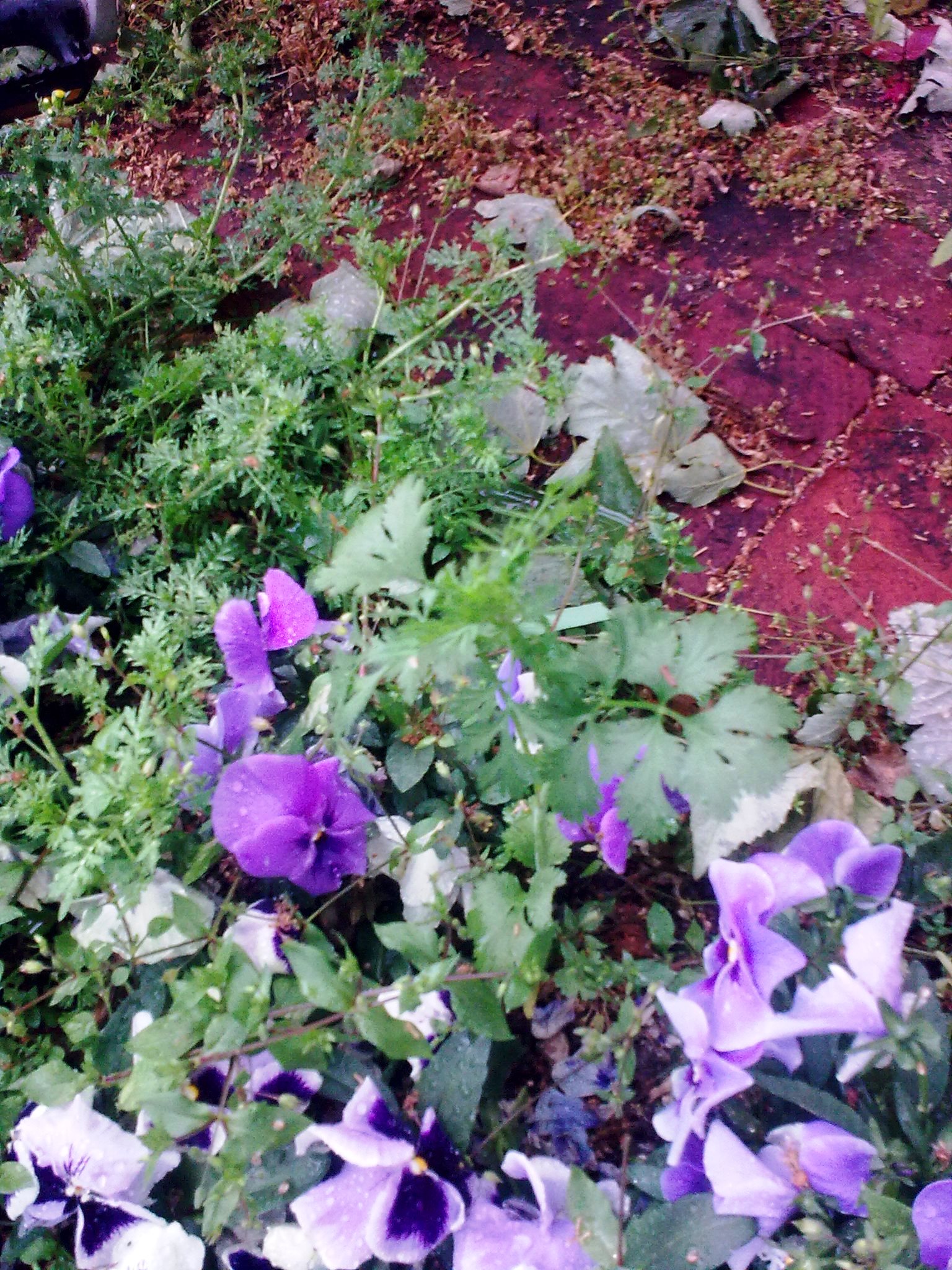
corianderAs we weeded the tree pits where we have planted pansies, we came across a thriving coriander seedling, far bigger than the ones carefully cossetted in the greenhouse. It’s hard to see in the photo, but it’s definitely there and wonderfully pungent.

How did it get there? Quite possibly in our compost. All kinds of things have appeared after we’ve mulched with last year’s compost: tomatoes, cucumbers, chard … Or perhaps we emptied old seed trays here when we planted the pansies? Or perhaps seeds blew in when we were planting seeds in April? Who knows? At all events, we marvelled …

Posted in Uncategorized | Leave a comment

Stuff I’ve learned

As the growing season has suddenly come upon us, I’ve been doing a bit of reading up and reflecting on some gardening conundrums.

Soil

John Harrison, in his wonderful Essential Allotment Guide writes about soil thus:

‘Your soil is made up of rocks and rock dust mixed with organic matter that we call humus [which] holds everything together and at the same time stops the rock dust from setting into a solid, cement-like mass‘.

This makes so much sense, as I despair at my garden soil which looks like  rocks (bits of chalk and flint) and rock dust set into cement. Not enough hummus … The station garden has been blessed with hummus rich soil as we’ve built it up from scratch in raised beds. Very little of our underlying chalk rocks and rock dust have gone into it.

Top or bottom watering?

Why, I was wondering, are our seedlings showing slight signs of nutritional deficiency? The tiny seedlings were planted up in early May in 7cm pots in a mix of peat-free multipurpose compost and vermiculite. When we’ve been planting them out now, I’ve noticed how the roots only show as a tangle at the bottom of the pot. They have been getting pot bound.

Eureka moment: we’ve done so much watering from the bottom, i.e. having the pots sit in water, so the roots have gone straight to the bottom. This may be a good thing, as once the plant is planted out, the roots should run deep. But it does seem to have meant that they ‘exhaust’ the 8cm pot more quickly than if watering had been done consistently from the top. Now I’m not entirely sure this is a plausible hypothesis; will probably need to check with a real horticulturalist … perhaps via the RHS advisory service we so far haven’t used?

Growing coriander

Many of us at the garden love coriander, but all of us have failed to grow viable quantities in the past. I know that coriander likes rich soil, and that to avoid it going to seed, it is useful to place it in partial shade.

Here’s a good summary from a US site, which confirms coriander that is not easy to grow:

Cilantro [Coriander] is tricky because several factors can cause it to bolt. Avoid transplanting for this reason, and avoid hot conditions as well as too much moisture. It does best in light, well-drained soil in partial shade, in relatively dry conditions. Once it blooms, the seeds ripen suddenly, in only a couple of days, so care should be taken to prevent self sowing or simply losing those useful seeds.”

What I hadn’t realised is that, of course, it has a long tap root, so it needs to be grown in deep soil. I’ve always tried growing it in a pot so I suspect the pots weren’t deep enough.

So I’m out now to plant out our coriander seedlings in a ceramic glazed pot 35cm deep (is this enough?) with a mixture of general purpose peat-free compost and our recycled organic matter mulch (should be rich enough). I’ll place the pot by the wall so it gets some shade. And assuming it grows well, we then have to be careful to remove any flowers.

We’ll see what happens …

Posted in Edible growing | Leave a comment

Compost oddities

Our compost features prominently in the life of our community garden at London Road Station. About 20 people who live in and around the area bring their organic vegetable and fruit waste to our compost bin. Many of these contributors don’t have gardens, so we are their only opportunity to compost. And we are very grateful to them.

It’s inevitable, thought, that different people will have different interpretations of what is compostable. In principle, it’s any organic matter that will decompose, but we exclude the obvious things like meat and cooked food as these can attract vermin, and we are composting in a public place. We also ask composters not to add egg shells for the same reason and fairly obviously, pet waste and straw or sawdust bedding is out too.

We do not exclude citrus material. The old argument has been that the acid in citrus juice and skins will slow down the compost process and/or kill the worms that help it. Apparently, if citrus material is only added in moderate quantities, and if it is shredded beforehand, this is unlikely to happen.

However, people have been adding things – quite understandably – that are organic, not cooked etc. but that take a long time to break down. We’ve found a wooden  toothbrush and coconut shells recently. These – along with tea bags and avocado stones – are a nuisance in our compost because of the way we have to organise it. We need the compost to be ready after 6 months ‘resting’; it takes about 6 months to fill one of our bins. And we have two. Anything that doesn’t thoroughly break down within 9 months or so will remain in the compost when we try and use it.

We already have too many ghost tea bags – the textile part doesn’t break down quickly – floating around the plot. Please no wooden items, no tea bags unless shredded, no hard fruit or veg shells or stones.

Composting is problematic if we get the balance of materials wrong. Currently, we’ve also had quite a lot of cardboard deposited. This absolutely needs to be shredded as otherwise, again, it won’t decompose in manageable time. Please avoid large amounts of cardboard or paper. We have a Compost Master who checks the balance of the compost regularly and will adjust with shredded cardboard etc. when necessary. But thank-you, composters. Your veg peelings turn into wonderful nutrients for our soils.

P

Posted in Composting | 3 Comments

June jaunts

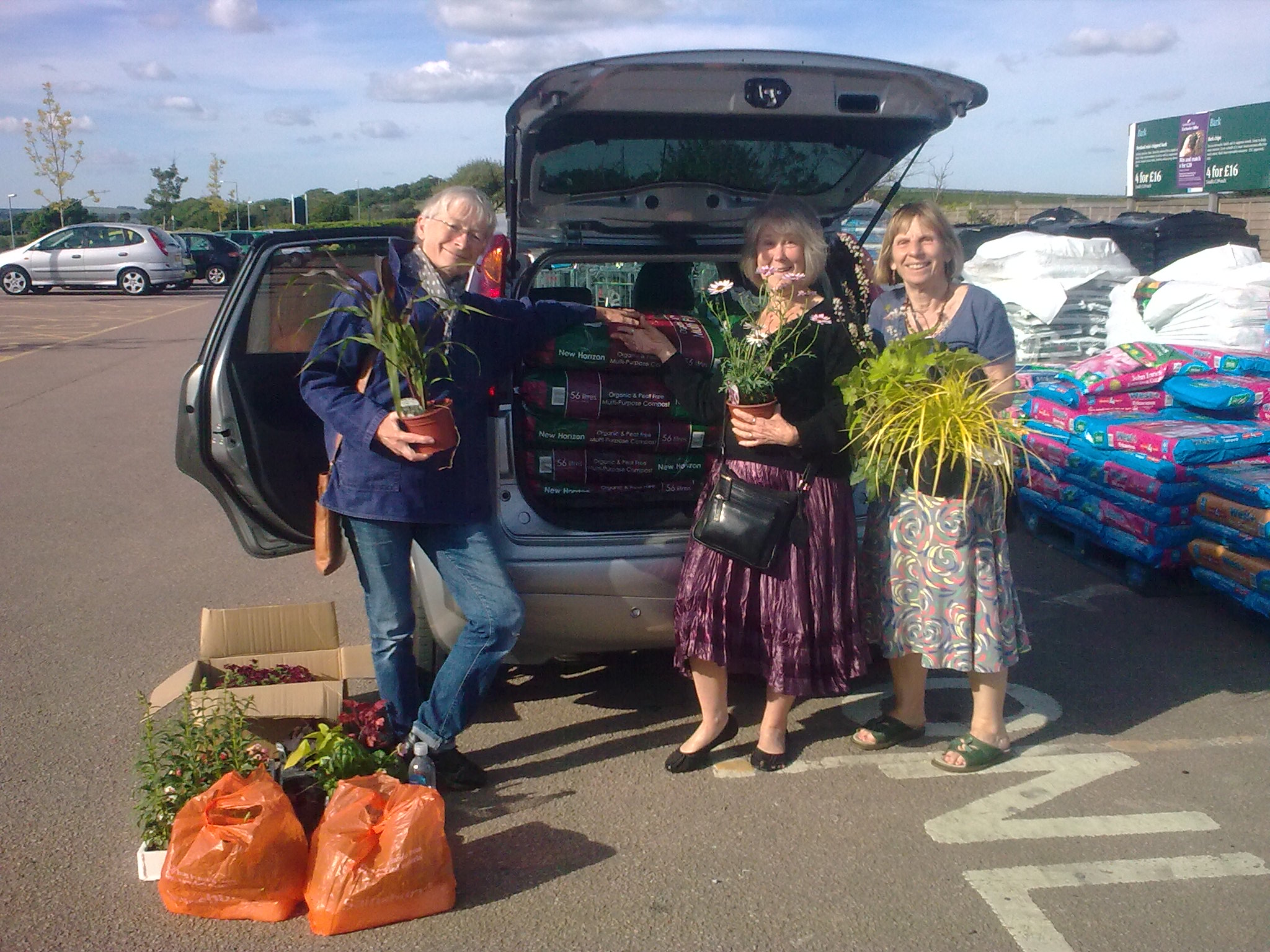
Or … how much can you get in a Nissan Note? Four gardeners, six bags of compost, eight trays of bedding plants, ten perennials and two herbs. Just as well we arrived late afternoon at Stanmer Nursery, otherwise I suspect plants would have taken the place of at least one gardener!

Garden centre outing

Posted in Events | Leave a comment

More on Preston Circus planters

Now the core perennials in the Preston Circus planters are taking root and giving us an idea of shape, we’ve started filling in with more plants, in particular some annuals which will eventually provide some colour.

The coastal planter

Coastal 3 6.13It’s been quite tricky trying to find the centrepiece for this planter. The original idea was an Agave americana but this is very tender. Instead, we’re trying what I think is an aloe plicatilis or as it was originally baptised Aloe africana arborescens montana non spinosa folio longissimo, plicatili, flore rubro – er … ‘African aloe tree-shrub from the mountains with very long non-spiny leaves in the shape of a fan with red flowers’. It grows VERY big, but only very, very slowly. Hence its use as an ornamental container plant. The dark green leaves and bright red-orange flowers should complement the blues and yellows of the santolina and rosemary. We’ve also planted a verbena bonariensis, calendula and some cornflowers. The lampranthus are flowering a brilliant orange and should drape over the edge along with the trailing rosemary.


The prairie planter (or ‘Circus Circus’ planter)

Prairie 1 6.13The lime green grasses at the four corners and the burgundy tinged miscanthus in the centre are working well. The bright grasses catch the evening sunlight beautifully. Eve added some deep red cornflower seeds, but we’re not sure if these are coming up. At the weekend, I added the cosmos seedlings – lighter pink and deep magenta with fluffy leaves which complement the euphorbia – as well as some wine red and some light green heuchera. We’ve also got nasturtiums growing. We’ll see how they look draping over the edge, otherwise maybe some of my burgundy annual verbena will work there.

The traditional planter

Traditional 1 6.13This is the most vulnerable planter as it is so near the Duke of York cinema. We’ve already had to put a low trellis barrier around it to stop people sitting on it. Sue planted it up with variegated pelargoniums and nasturtiums have seeded everywhere. It must be the compost we added to this and its ‘sister’ Cottage garden container. The nasturtiums will drape over the sides, but they may be a little too boisterous. They are currently trying to upstage the lavender plants planted at the four corners, which are coming into flower. The cornus in the centre is not growing much, but it’s a shrub and I’m assuming it grows slowly. The purple sedums are rather unruly at the moment, as they will be in their first year. We’ve already had several broken stems, but they are propagating more plants in my greenhouse.

The cottage garden planter

Cottage 1 6.13The pinks are the real eye-catchers in this container, and the perfume is delicious. In true cottage garden style, nasturtium seedlings are growing up through the alchemilla mollis and there are tomato seedlings and even a courgette growing up in the compost. The acanthus mollis in the centre is growing slowly, but my acquaintance with this plant is that it will put on a growth spurt suddenly. Diane and Madeleine planted four purple aubretia to drape over the sides, but they are sulking a little – again, as young aubretias sometimes do when the weather hasn’t been too warm. The purple of the aubretia works well with the pink of the pinks, both plants with silver blue foliage, offset by the leaf shape and lime flowers of the alchemilla.


Posted in Preston Circus planters | Leave a comment

The High Line … the Greenway?

Highline herbaceous cropped Highline 1I can’t help it … wherever I go, I end up seeking out gardens. The highlight of a recent visit to New York was The High Line, a derelict above-ground railway line which has now been transformed into an extraordinary park. It runs one and a half miles down the West side of Manhattan between 30th and 14th street.

Work on constructing The High Line started in 2006, following a campaign by local residents to preserve the old railway, which had been taken over by wild plants. The main garden designer for the project was Piet Oudolf, known for his landscapes composed of beautiful sweeps of perennials and his commitment to sustainable, robust but beautiful public planting. (He is part of Future Plants, the company that promotes the use of the ‘new perennials’, often neglected in earlier public planting projects. The list on their website is a really useful checklist for plant selection.

As you can probably judge from my photos, I visited The High Line on a dull rainy day; even in these least favorable conditions, The High Line was breath-taking.

Highline heuchera Highline heuchera and lime grass Highline heuchera and lime grass 2 Highline grasses and heuchera green Highline purple sedum alliums Highline geranium bed Highline sedum cuHere was really effective planting – and great to see some of our favourite plants: burgundy heuchera against lime green grasses, silver streaked lamiums, sedums galore, alliums and geraniums.


Highline nepeta cu Highline salvias Highline perennial field 4 Highline purple sedum alliumsThe plants we have not thought about using are the salvias and nepeta (catnip).

We’ve avoided the former as they are tender annuals (and the lovely volunteer on The High Line booth confirmed that there was extensive replanting each year, something we want to avoid).

But catnip would fit, perhaps not in the shady garden where they might attract local cats, but in the Preston Circus Planters?


The wonderful planting, though, is just the micro level. The macro level inspiration is about finding public spaces made beautiful in unexpected ways. So much of the design of The High Line is about inviting people in, integrating people and planting in a harmonious space with benches, arbors, even a sun deck.

Greenway northI can’t see us getting New York-esque café tables and chairs set up around the Preston Circus Planters, but … what about The Greenway? If you don’t know it, it’s a recently opened ‘nature reserve’ and walkway along the path of an old railway line at the back of Brighton’s New England Quarter. It leads over the Victorian iron bridge, crossing New England Road.

Opened after long negotiations in 2011, our Greenway now looks miserable, unloved, tattily planted and increasingly tagged. Can’t we celebrate our railway heritage here, and make our very own High Line?

Greenway to NE house tools

Greenway south


Greenway seats tagged Image2636 Image2630 Greenway tools graffiti Greenway vines graffiti Greenway


Posted in Public green spaces, The Greenway | Tagged | Leave a comment

Early season queries

Cavalo nero seedlingsThough today was cold and rainy, and our gardening session had to be changed into tea-and-talk in the conservatory, things are finally growing. Gardening is starting to feel like gardening again. As we watch the plants bursting into leaf after the winter, it’s time for questions:

Are our leeks ready?

Image2656We seem to have leeks at two ends of the growing spectrum: lots of seedlings on the one hand and overwintered plants which look like they may be going to seed on the other. What do we do?

Our large leeks have been in the ground since the seedlings were planted in August last year after our onion crop had been harvested. My books say: ‘leeks can remain in the ground until they are required for use’ and ‘most leeks are harvested mid-winter to spring’. Our leeks were spindly until fairly recently when they have started to thicken. They certainly weren’t ready to harvest mid-winter.

I think the only thing to do is to harvest them and try them: leek and potato soup (the weather is still cold) or leek omelette are recipes that spring to mind.

Our small leeks have been grown from seed sown on April 14th. We need to pot them on ready for planting out when we find some space. The books say: ‘transplant to final positions in late May and June’ so we’re more or less in synch with the normal cycle. Our seedlings need to be ‘pencil-thick’ and ‘6-8 inches high’, so they have a bit of growing to do.

  • Lift some of the leeks and try out in recipes. If OK, lift the rest.
  • Work in good amount of mulch into the old ‘leek’ bed, soon to be the bean bed.
  • Thin out and pot up leek seedlings in 12cm pots of compost, to wait for final planting
  • Harden off seedlings outside for at least 2 weeks before planting

What about our strawberries?

We’ve only just got flowers on our strawberry plants so it looks like we’re well behind the normal schedule; surely, strawberries should be fruiting by now? One thing we have learned is to cut off the leaves immediately after plants have fruited. This last summer, we didn’t really do this, and were uncertain whether to do it in September/October when we were clearing the plot. It should be done around August.

Ripening black currants, red currants

‘Heavy manuring and high summer moisture’: our black currant and red currant bushes in pots are looking very lush with lots of berries. I’m wondering whether we should be thinning the leaves to reveal the currants to the sun, or whether this will just have the effect of encouraging the birds to take them.

  • We do need to mulch, ideally with manure.
  • We should probably try to protect from our increasingly friendly blackbird couple
  • A feed of sulphate of ammonia is also advised, if we are going to use inorganic fertilisers.
Posted in Uncategorized | Leave a comment

Mid-May update … cold, wet but progressing

May started with hot weather (finally, up towards 20C) and we were worried again about keeping seedlings out of the sun and plants well watered. We even had the shading up in the greenhouse. The rain started again, though, on May 8th and the temperatures plummeted. They don’t seem to have risen much since then …

Here’s Diane’s mid-May update from 14th May:

“I ventured to the garden this afternoon to check out the ‘umbrella theory’!   Because this fine rain has so little power, the leaves tend to shelter the soil from the rain – and yes, indeed, even under the big spinach leaves the soil was completely dry!  I picked the big leaves on the ‘cut and come again’ model, and watered that area, and others which were dry in spite of what seems like useful rain.

The water butts are healthily full, and Mark has transferred water to Madeleine’s old water butt for emergency use when the drought eventually comes.  Great!

In spite of the cold, things are really on the move!  Madeleine’s carrots are shaping up, as are the radishes, and those seeds (the slow ones) are up – garlic chives, rocket and…. not sure what some are.

There is cut-and-come again salad in two troughs – we do need to eat them to keep the salad going for the season.   I picked enough for 4 people yesterday, and it hardly shows!  They were delicious….

Posted in Edible growing, Weather | Leave a comment

Community in ‘community garden’

Todmorden lovage w labelIt still delights me and makes me smile … the ‘community’ in ‘community garden’ really does exist. We’re finally getting into the swing of our Tuesday afternoon gardening sessions after  the long drawn-out winter. The weather has been warm, the seeds are germinating, the plants are growing back. Among the shoots we weren’t initially able to identify, but now growing strongly, is the beautiful plant I have named ‘The Todmorden Lovage’. Mary from Incredible Edible Todmorden gave it to the garden last year when we visited their inspirational town. It’s a connection to a fantastic project and an amazing group of people.

And so far this year, locally, we’ve had even more people dropping in, passing by, getting involved while we’re in the garden. On Tuesday, we were five pottering around watering, potting on seedlings and checking planting in the shady garden. We were joined by Eve, by various neighbours who dropped by to see the fruit trees, by Marlene who – as always – brought things for us to plant and by a little girl, keen to water and dig, who had been waiting on the platform with her Dad.

Digging in clematis 30.4.13 4 in garden 30.4.13 Girl and Diane 30.4.13 Diane Marlene 30.4.13 Girl and EB 30.4.13


Our guiding principle – that we build the gardens with whatever resources and people come our way – seems to work, and it’s lovely now to look at the planting in the shady garden and think: ‘that came from Sally’, ‘that came from my mum in Wales’, ‘Diane brought that over from Preston Park’, ‘that came from the neighbour in Shaftesbury Road’. A week or so ago, a neighbour left a hemerocallis for us, and this week we were planting a tough old clematis – I think it’s Clematis ‘Victoria’ with large purple flowers – which has been in a pot on my patio for years. And next to our Big Dig banner, Marlene’s clever hanging flowerpot and single daffodil serve to announce our community garden.

Anders' gardenMore connections on Saturday, when I was showing the garden to Juliette from Holland, another neighbour dropped by. He had developed his raised beds at the same time as we had, and he was keen to see how ours were doing.

In the conversation, we discussed local apple varieties and he mentioned that he had grown some seedlings from the old apple trees in the orchard at the back of the houses in Shaftesbury Road before this odd patch of land was sold on.

As he wasn’t sure he would be staying in the area, he asked if we would like the seedlings. We picked them up later Saturday morning and visited his amazing raised beds (see photo), full of a rich array of edible leaves and clever arrangements for watering with roof water.

Apple seedlingsThe  seedlings – two apples, two pears – are now sitting next to their older established cousins in ‘our’ mini-orchard. It would be wonderful to be growing our very very local Shaftesbury Road varieties, but I think we might need the horticultural expertise of Brighton Permaculture Trust to grow them on.

From little things  great things grow.

Posted in Uncategorized | Leave a comment

Pruning plums

Our plum tree 4.5.13We had help with pruning our apple and pear trees back in the winter. Spring is now here – finally in May – and the trees are starting to bud and flower.

But what about our plum tree in a dustbin? It started tall, but seems to be doing well with buds and leaves coming through. Pruning for plums takes place in spring and early-mid summer to avoid infection by silver leaf disease.

I was discussing this with Nick at London Road Station, and thought I would chase up the full advice on pruning plums. Below is the summary from the RHS site. We will be following the advice for Pyramid plums for our plum tree as it is St Julien root stock. My neighbour and I have also planted Pyramid plums in our front gardens and my two have grown extensive leader shoots.

Time to find out more … there’s also good, simple information from BBC Gardener’s World and Tree Maintenance Ltd

When to prune plums

Avoid pruning plums in winter, as it increases the risk of infection by silver leaf disease to which plums and other Prunus species are prone. The best time for pruning is usually spring for young trees and mid-summer for established ones.

How to prune plums

There are three commonly used methods of pruning plums: bush, pyramid and fan.

Bush

The bush is perhaps the most popular method of training and pruning and creates an open-centred tree with a clear stem of 75cm (2½ft). Its ultimate size will depend on the rootstock it is grown on. Trees grafted onto ‘Pixy’ rootstocks will reach 3m (10ft), ‘St. Julien A’ 3.6-4.5m (13-15ft) and the ‘Brompton’ and
‘Myrobalan B’ 6m (20ft).

The overall aim of pruning is to create an open-centred tree. This begins with the same formative pruning as apples and pears but, importantly, carried out in early spring.

On established trees, rub out any buds developing on the lower trunk and carefully pull off suckers arising from the rootstock. Pruning is mostly limited to removing crossing, weak, vertical and diseased material. If the plum tree is still crowded then further thinning can be done in July.

Pyramid plums

A pyramid plum tree is considerably smaller than a pruned a bush, and this makes it practical to net against birds. Plums on ‘St. Julien A’ rootstocks are kept to 2.4m (8ft) and on ‘Pixy’ rootstocks to 1.8m (6ft).

The pruning of a newly planted tree is the same as for apples and pears. Remember: carried out in April not winter to avoid silver leaf disease.

Afterwards the initial pruning, follow these steps:

  • During the first summer, prune in the third week of July when the young shoots have finished growing. Shorten new branches to 20cm (8in), cutting above a downward or outward-pointing bud. Also cut side branches back to a bud at 15cm (6in). Train and tie in the central leader to the stake
  • In subsequent years during April, shorten the central leader by two-thirds. Repeat annually until the tree has reached 2.4m (8ft) on a ‘St. Julien A’ rootstock, or 1.8m (6ft) for ‘Pixy’, after which, shorten the central leader to 2.5cm (1in) or less each May, to keep the tree at the same height
  • Vertical shoots at the top competing with the central leader should be removed in late June

Fan training

fan-shaped tree is created by training against a wall or fence with horizontal wires fixed 15cm (6in) (or two brick courses) apart. Trees can be bought as maidens, or partly trained. Expect the height and spread of trees on ‘Pixy’ rootstock to be 3m (10ft) high by 2m (6½ft) spread and trees on ‘St. Julian A’ to be 3.6m (12ft) by 2.4m (8ft).

Neglected and overgrown bush trees

Renovating an old, neglected plum tree should be staged over several years. Aim for a well-balanced tree, keeping the centre of the crown free from shoots to allow good light penetration. Trees respond to larger pruning cuts by sending up a mass of new shoots. Where this happens the shoots will need to be thinned in the summer to leave just one or two.

Controlling vigour

The tying down of young, flexible branches to the horizontal can reduce excess vigour in large, unruly trees. This technique is known as festooning and is best done in the summer and can help prevent trees becoming overgrown.

Ties are left in place until the branch stays naturally at the new position, usually the following spring. Attach one end of the tie to the branch tip and the other end to a stake or the trunk.

Problems

Plums can be heavy croppers, leading to branches breaking under the weight of fruit, so thinning is important to prevent damage. Branches already broken should be pruned back into undamaged wood, ideally cutting back to a natural fork to avoid leaving stubs.

The other main problems are silver leaf diseasehoney fungusbacterial canker,pocket plumplum aphids and plum moth.

Posted in Uncategorized | Leave a comment