Waiting

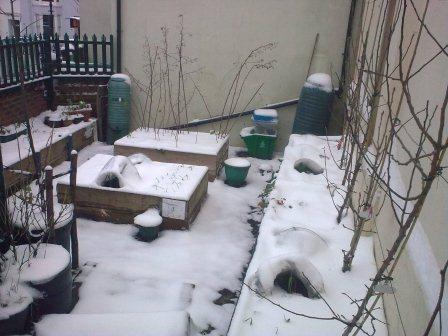
Gated plot 1.13 snow cWe are waiting. Gardens in the winter are suspended, resting …

It’s been wet, very wet since the beginning of December and we had strong winds. The New Year was wet again, and then last week, the snow came and stayed for a week. Today felt like the first day for a long time when the sun appeared and we saw greens and blues again.

Friends and London Road Station gardeners have all said the same thing, rather apologetically: ‘I haven’t been past the garden for ages’. But there’s no point trying to do anything. Nature is in hibernation, it’s pointless to interfere. The garden is asleep.

Orchard 1.13 snow cI ventured by just before the snow fell. It all seems to be surviving. I put plastic cloches over our leeks and our frisee lettuces, and over some of the onion and garlic shoots. If I remember rightly, the onions and garlic are both overwintering varieties; they should be fine.

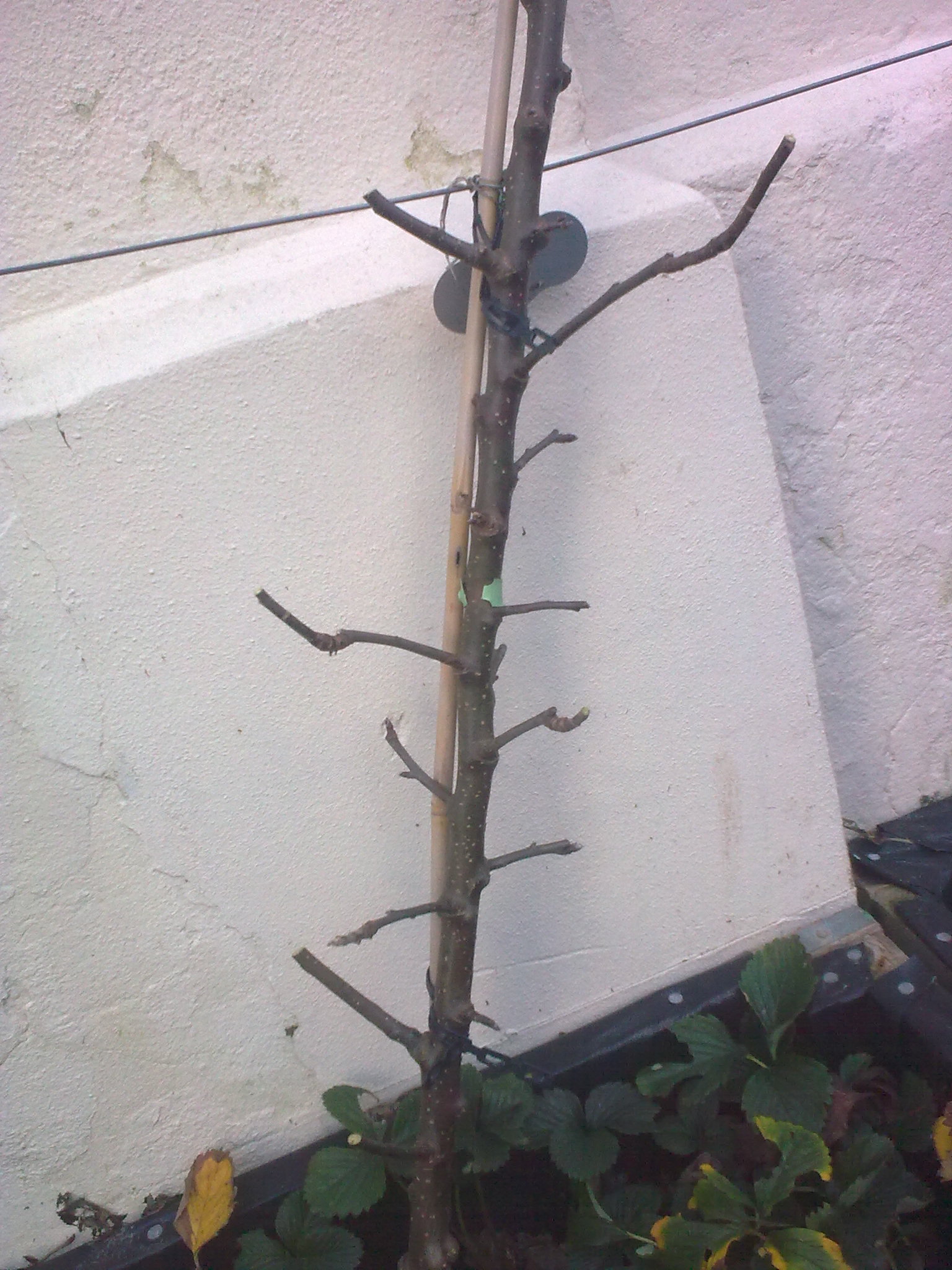
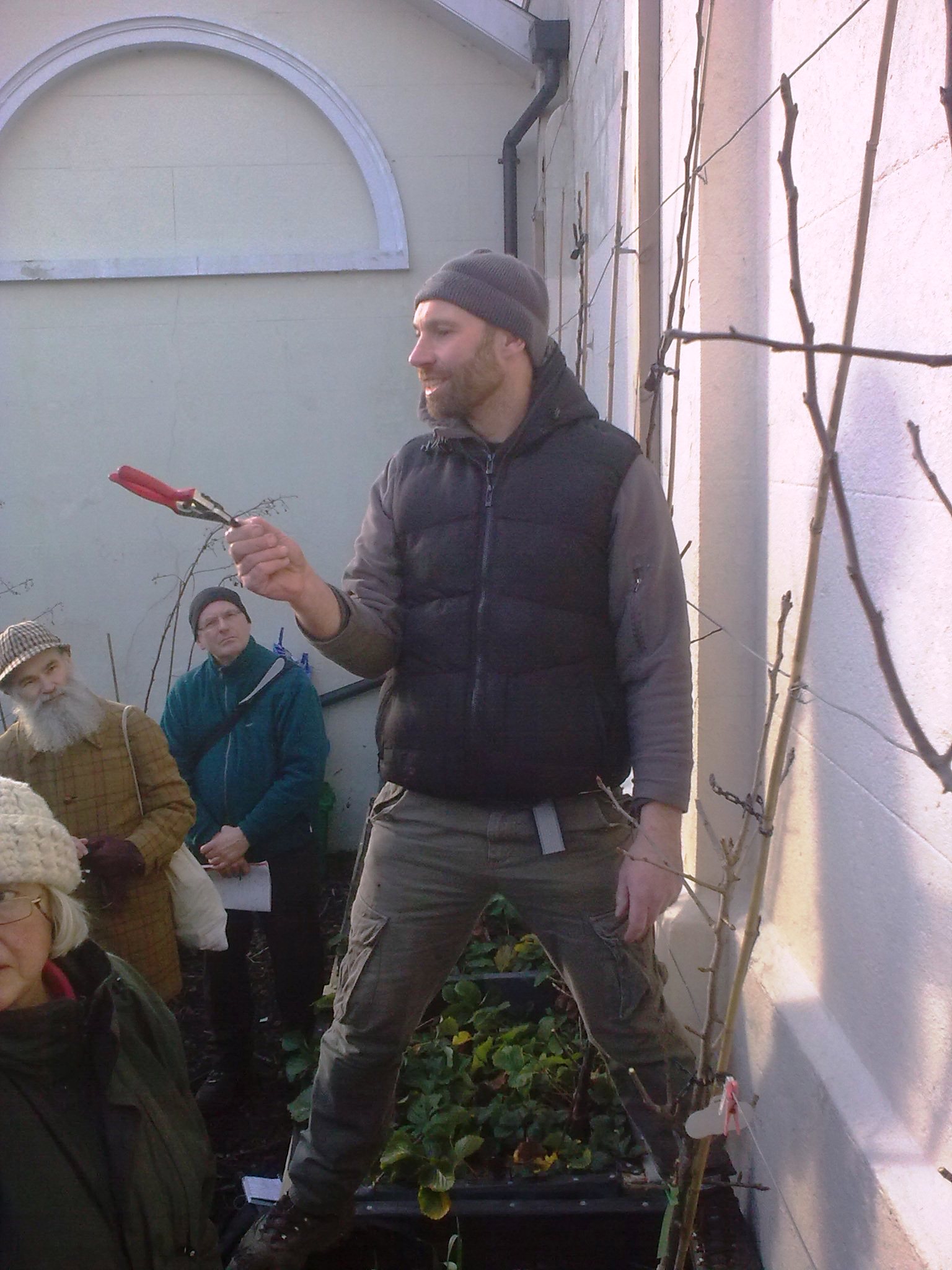
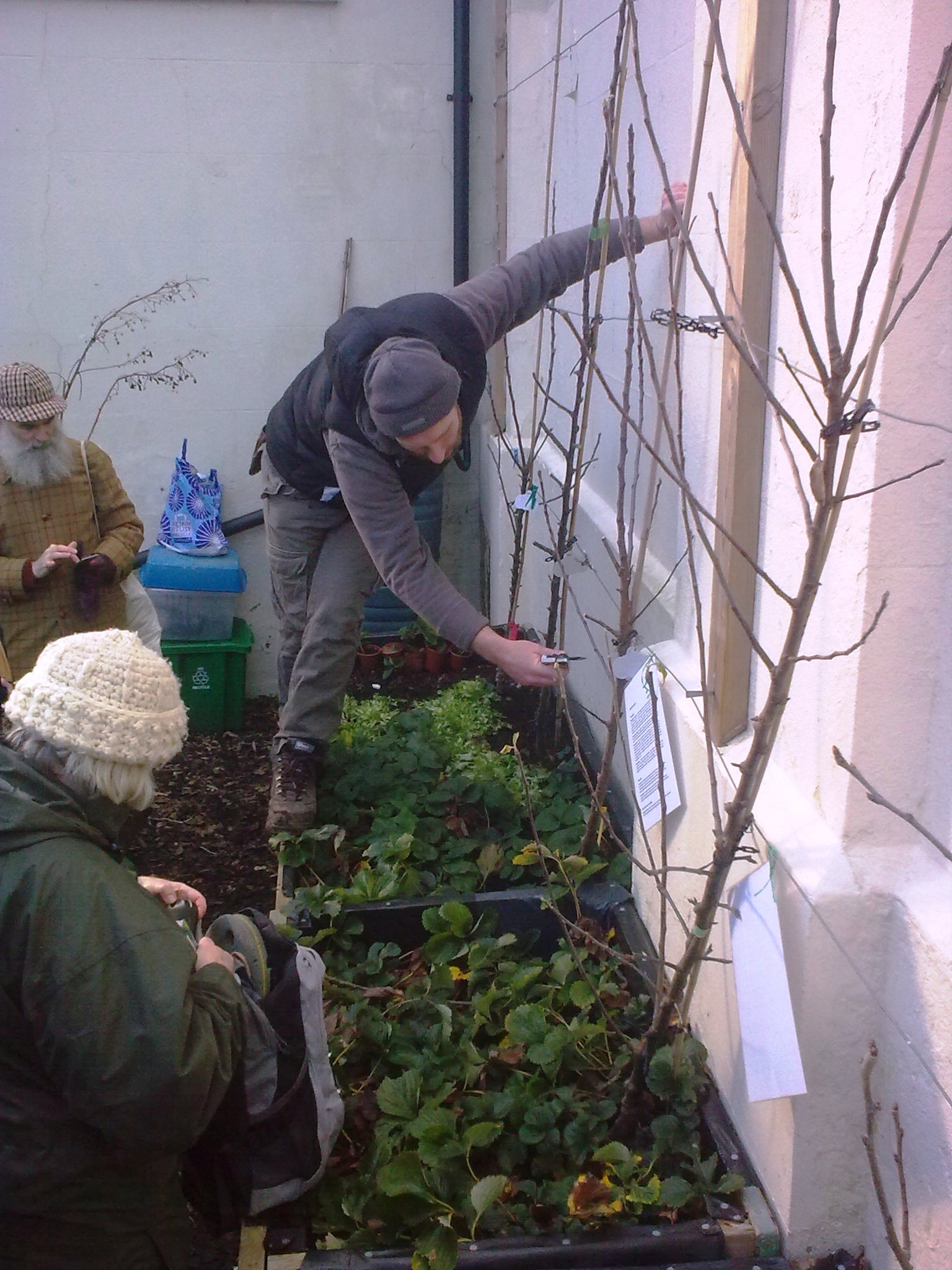
In the orchard, the leader stems of the fruit trees are growing away from the diagonal, but Bryn Thomas from Brighton Permaculture Trust is coming to prune next week. We will need to prune the raspberries and the black currant soon, but not a good idea to do anything while it’s freezing.

Shady fatsia snow 1.13 cIn the shady triangle, our two shrubs, a fatsia japonica and a mahonia japonica are really doing well, thanks probably to the amount of moisture in the soil.

Everywhere the shoots of all the bulbs we planted are coming up. Our cyclamen have maintained their bright spots of colour against the washed out greens and browns.

It’s resting time, recovery time, planning time. Already, though, we’re planning events. Things happen quickly once winter ends.


Posted in Uncategorized | Leave a comment

2012 in review

The WordPress.com stats helper monkeys prepared a 2012 annual report for this blog.

This blog got about 3,400 views in 2012. We’re delighted people have wanted to find out more about what we do. It would be lovely to have some more comments and find out what you’re doing out there, in community gardens, edible growing sites, mini-orchards and unloved municipal planters!

Click here to see the complete report.

Posted in Uncategorized | Leave a comment

Space for Growing Food

You can tell it’s winter. The layer of frost on my raised beds is a give-away sign, but more than that, I’m indoors. At a computer screen. Catching up on all those interesting documents I haven’t had time to read, following all those interesting links, imagining all the funding opportunities we might bid for. Not getting out to check whether the frost has wilted the lettuces.

First up today was the incongruously benign guide Space for Food Growing from the Department for Communities and Local Government. Its tone is more the jolly encouragement of a self-help book rather than the dry prose of a government policy paper. Its message: “Go forth, gardeners, and take over unused land, for grow-your-own gardening shall contribute to community cohesion and protect you from climate change”.

It’s so easy: no need to wait for an allotment plot (for our nearest allotments, there are 389 people on the waiting list with a waiting time around 5 years!). No, you just “… find other land which could be easily converted into allotment plots or community gardens, such as derelict public or private sector land; green space surrounding social housing estates; or land owned by a school, a residential care home or hospital.” A great idea … but there’s something rather naïve about this guide.

It’s great that a government department appears to be promoting the idea of community land use, and encouraging us citizens to look again at the potential of the unused space around us. But very little of this is new, and very little is about concrete strategies or coordinated funding streams. The references to case studies are useful as are the links to helpful organisations at the end. For example, I only recently found out about The Federation of City Farms and Community Gardens and the work they do on community leases. I’m really taken by the idea of Meanwhile Leases for using land temporarily where development has been halted by the recession, as appears to be the case opposite London Road Station (see earlier post).

So perhaps this is the point: all the useful stuff in Space for Growing Food comes from grassroots projects that have been driven mostly by the energy, investment and imagination of volunteers. I remain to be convinced that the Government has, in any real sense, ‘committed to measures that will enable individuals and communities to gain access to the land they need.’ (p.1). There’s a cynical part of me that is wary when a government department appears to jump on a bandwagon. Or perhaps it’s just that it’s winter …

Posted in Edible growing | Leave a comment

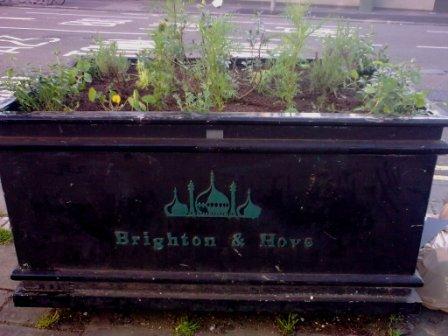
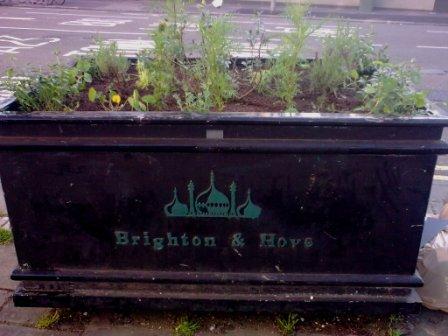
Update on the Preston Circus Planters

It’s been a year since we first started to talk about what could be done about the Preston Circus Planters. During this year, we’ve actually accomplished quite a lot. Thus far, our efforts have been temporary and experimental, planting mainly with annuals, but people did notice the colourful displays, and we were able to keep the plants going throughout the very unpredictable summer.

We now have a small grant from Community First to support the replanting of the Preston Circus Planters, so in this dark and dreary end of seaon, it’s a good time to reflect on the year.

First, back in March, we cleared the planters of weeds and sickly plants. Lavenders, red hot pokers and vincas were potted up to wait until we could replant them again.

At the end of May, we finally managed to get Brighton & Hove City Council to replace the growing medium in the planters, but just as the weather turned very hot and dry.

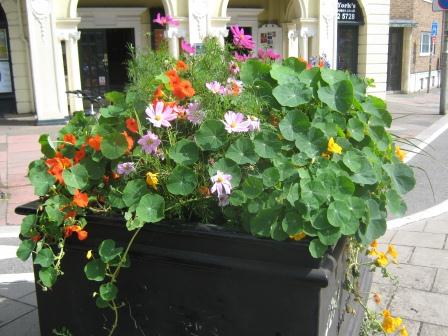
We planted up the two planters nearest the Duke of York’s cinema with plants we’d seeded ourselves – pink cosmos, orange and yellow nasturtium and marigolds – as well as the lavenders and vincas. We put generous amounts of water crystals in the soil, and covered the top with a permeable membrane to reduce the amount of evaporation.

At the end of June, wearing our yellow hi-viz jackets and masks to filter just a little of the pollution, we planted up the two other planters with a range of annuals and some of the remaining perennials we had rescued.

At that stage, Brighton was still officially in drought! A group of neighbours formed a watering rota, and could be seen in the summer evenings lugging full watering cans down to Preston Circus. Luckily, the Preston Circus Fire Station agreed readily to allow us access to water, so keeping the planters from drying out became a little easier.

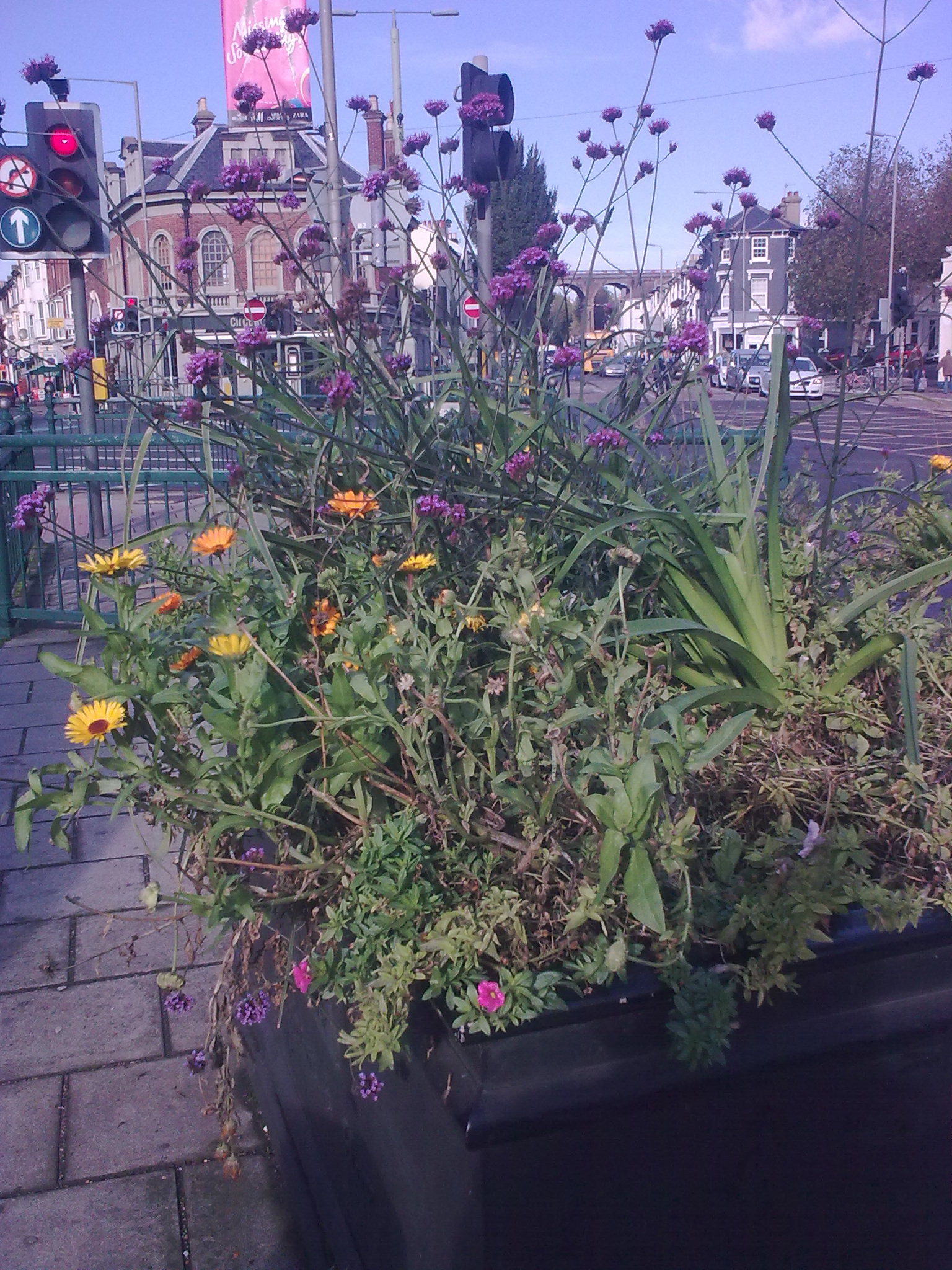
Of course, from drought in the spring, we moved into the wettest summer on record. The cosmos, nasturtium and marigolds benefitted and grew lush, tomato plants appeared from nowhere in the planter by Circus Circus, and the straggly verbena bonariensis grew tall and architectural in the ‘purple’ planter on the south side of the Circus.

Sadly, the two planters nearest the Duke of York’s were badly damaged during Pride at the end of August, but the ‘purple’ planter (now with marigolds that had strayed in from somewhere) was still going strong even at the beginning of November.

Yes, people throw bottles, cans, cigarette ends and plastic bags into the planters. People have fallen against them, leant into them and squashed the plants. The sun and the wind are also unforgiving. But they did survive …

We now need to set up a good source of water before planting. The floral display needs to have height and colour in order to have impact. The planters themselves need painting. And we need a team of volunteers to care for the planters.

We’re planning now to clear the planters of the remains of the annual planting and mulch to improve the fertility of the soil, ready for planting in early spring. Unfortunately, the wind and heavy rain put paid to our good intentions this last weekend, and it looks like frost is promised for next weekend. The unpredictability of the weather this year continues …

Building on our experience this year, we now need to plant for a rather more long-term strategy – and think about how we can use shrubs, perennials and annuals to create an all-season display. Do get in touch if you’d like to be involved: pcplanters@hotmail.co.uk or through this blog.

Posted in Preston Circus planters | Leave a comment

End of the season

It’s getting cold. It’s sunny out there but the blue sky belies the real chill in the air. The light is fading now at around 4.30pm. With the low sun blocked by surrounding buildings, the gated plot is in shadow much of the afternoon. It’s the end of the growing season.

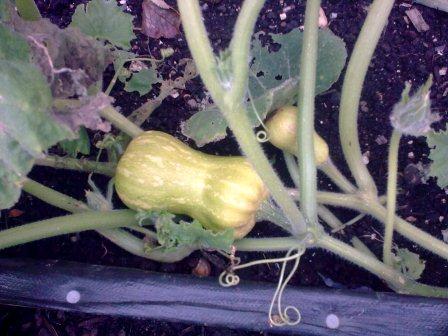
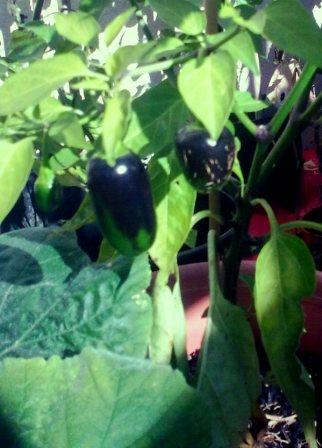
We’ve cleared the beans, the leggy yellow courgettes (both successful this year), the tomatoes which never got beyond green, the peppers which went black, and the amazing squash in a 12″ pot which by rights should never have fruited. Last week, we harvested two squash.

We’ve lifted the beetroot and thinned the frisee lettuce seedlings which should survive the cold. We debated whether to cut back th lush leaves on the strawberry plants, but decided the cold would probably do this naturally. We’ve potted up plantlets for next year. 

The autumn-fruiting raspberries have been left to be expansive, some of their leaves turned to filigree by moths and caterpillars , still producing beautifully coloured berries but sadly with no flavour. We’ll cut back the tops of the canes now to stop the wind whipping through them (thanks, Sue, for this tip) and wait until the winter for pruning back to base. 

Meanwhile our orchard is looking very healthy. The trees have grown quickly and the leaves are still glossy dark green. And our salad bed is at risk of becoming a mint bed, as the mints run away gleefully with all the moisture in the soil. Madeleine cut them back last week, but we’ll need to keep them in check.

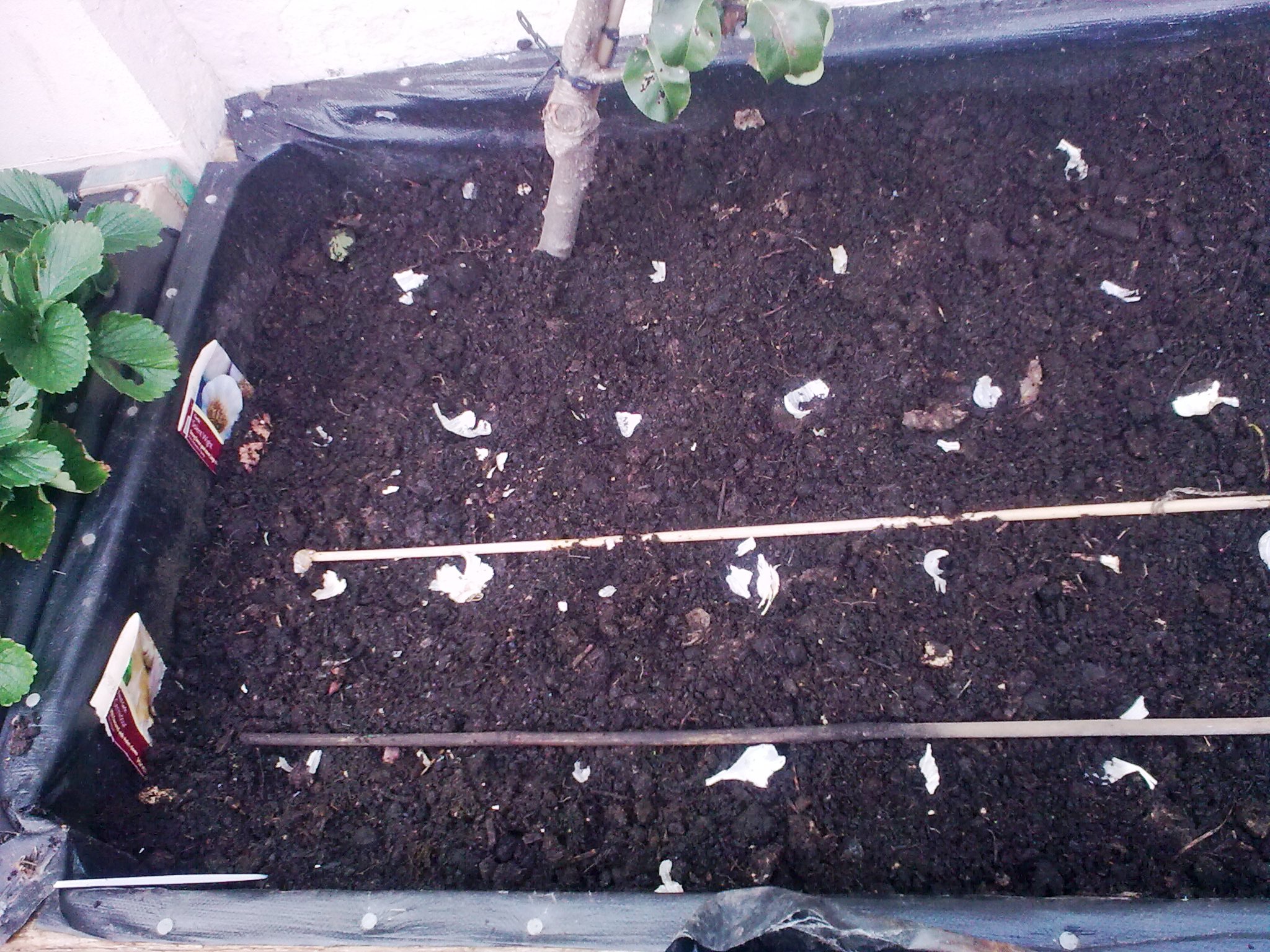
We’ve planted overwintering onion sets where the beans were, and two varieties of garlic in front of the pear trees. Madeleine used the skins to indicate where the bulbs were planted. We planted winter leaks back in late August. They were looking a bit straggly but should benefit from new mulch and a bit more space now the courgettes are gone.

And we’re mulching … I think the recycled vegetable waste mulch we were donated by Countrystyle last March has been the key to success this year, and we’ve still got quite a bit left. Or could it have been the stable manure, the nettle-rich soil from Brighton Permaculture or even Mark and Daphne’s old wool carpet at the bottom of the central raised beds? This year, of course, we also have our own superb compost (thank-you, composters). These last two weeks, Mark has been creating our own mixture – London Road Gold? – made from one part compost, one part Countrystyle mulch and one part spent grow-bags to dilute it.

Posted in Uncategorized | 2 Comments

Harvest supper 2012

It’s harvest time again. This year’s produce was rather more substantial than last year’s but with different successes and failures. This is the basket of final pickings that went into our harvest supper last Friday.

Posted in Uncategorized | Leave a comment

Fighting for Flora

At London Road Station, we’re gardening on two tiny plots of land. We’re getting to the point where we could certainly work with more land. Every Open Day we have, more and more people express an interest in gardening with us, and in composting.

The piece of land opposite us on the North side bordering the railway line used to be allotments. I can remember passing through London Road Station back in the mid-1970s and being amazed by seeing rows of sweet corn, beans, lettuces and beautiful flowers in such an urban environment, only two minutes out from the centre of Brighton. It was like arriving at a quiet oasis, almost lost in time. The original platform canopy was still there in those days, and I remember the impression was one of an Agatha Christie period film.

Sadly, the old canopy on the North platform was demolished in the 1990s. More recently, the ‘old allotments’ site itself was sold on to a developer. The proposal to build flats on the site right next to the railway, and in an area of very high housing density, was energetically fought (neighbours got together as FLORA – Friends of London Road Station Allotments), but was finally given the go-ahead at a national appeal.

So far, no building has taken place, but a planning application has been resubmitted for building flats on this site (you can find it on Brighton & Hove’s planning site here). The area has now grown up with trees and shrubs. It is acknowledged that the railway line is an important wildlife corridor.

We’d love to think… that in an area where there is very little green space immediately available, and where many households are living in flats without gardens, the ‘old allotments’ could become the much needed ‘new allotments’ – a focus for the local community, as our existing LRSP gardens have shown is possible.

Posted in Uncategorized | 2 Comments

Water and compost

It’s a busy time again in the London Road Station Partnership garden. We’re back to the challenge of water. Brighton has had a warm late summer, and there’s been no rain for the past 10 days or so. Our two (and a half) water butts have run dry. We’ve focused our watering on the vegetables and fruit in the gated plot, but yesterday, we tackled the shady triangle.

This area is under a tree canopy and we’ve not watered regularly. Despite several generous mulchings autumn and spring, and our very wet early summer, the soil was rock hard. Yes, it really has been the dryest wettest year on record!

Yesterday, we had to take drastic action and string a long hose from Madeleine’s house to fill up both water butts and give both gardens a thorough soaking. Yes, we need to install at least two more water butts before next spring/summer.

To try to break up the soil and keep it moist, we decided to ‘unpack’ our mature plastic compost bin . We’ve spread some of it on the shady triangle.

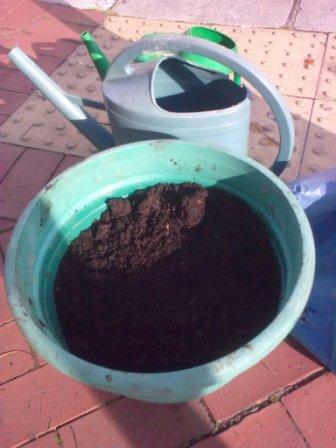
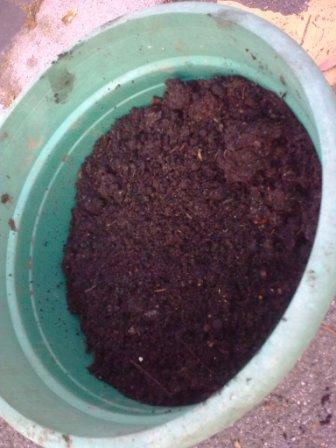
The stuff is wonderful – everything that compost should be: moist, friable and bearing no resemblance to the component waste which went into it November to March (see blog 22 March 2012). It’s so lovely it deserved a special photo shoot all of its own.

Our second wooden bin is now full, and can be left to mature until the spring. The black plastic bin is now the ‘active’ one. Given the interest in composting from people living around here, we’ll probably introduce a third bin shortly.

So far, our composting scheme has worked very well, and now we’re seeing the results. We should have enough to spread on the raised beds of the gated plots, once we clear the vegetable plants.

Posted in Composting, Weather | Leave a comment

Raspberry harvest

Or perhaps Harvest’s raspberries?  Back in January, Harvest distributed free raspberry canes to community gardens in the city as part of their efforts to promote edible growing (see January blog).

We had four. We planted two in the shadier central raised bed, and the other two in pots nearer the railings. The whole point of the canes was that they should be in publicly accessible places to positively encourage people to pick them when passing by.

The two canes in the raised bed have done spectacularly well (see left). We’ve had raspberries, the kids on their way back from Downs school have had raspberries and visitors to the garden this weekend had raspberries.

In fact, everything we planted in the raised beds has done well. It’s probably the mixture of garden top soil, stable manure and Countrystyle mulch. And the canes have put out new shoots which we can dig up and replant elsewhere. It helps also that the raspberries have been regularly watered – much credit to all those who’ve kept the garden going over our highly unpredictable summer –  and they are not in full sun.

The two most accessible canes are planted in large plastic pots with the bottoms cut out. We took special care over the planting medium: I think it was John Innes number 3 (a soil-based compost) together with some well rotted stable manure or chicken manure pellets, and topped off with the Countrystyle mulch. The plants are doing well, but compared with the ones in the raised beds, their leaves are a little yellower, they are not as big and they have fruited less – which is a bit of a pity, precisely because these are the accessible canes. However, I discovered yesterday that they are doing what they were intended to do.

A neighbour was passing while I was in the garden, and as usual, stopped to chat about how things were growing. He mentioned he was thinking about planting pear trees in his front garden, but wondered whether people would steal the pears. I said that so far, we’d had very little evidence of anti-social behaviour, either in our gardens or in my front garden where I’d planted fruit trees.

‘Ah, but people must be stealing off those raspberry canes’, he said, pointing to the pots near the railings. ‘That’s what they’re there for’, I explained. ‘Oh, that’s good’, he replied. ‘because somebody’s definitely been pinching ’em’. I looked quizzical. ‘Yes’, he grinned, ‘and they were very good’.

Posted in Edible growing, Uncategorized | Leave a comment

Photos from SE in Bloom

Elspeth Broady and Mark de Boissiere receiving the LRSP ‘It’s your neighbourhood’ certificate from Chris Collins, Blue Peter gardener.
13 September 2012. c. Nigel Bowles/John Connor

Chris Collins at South East In Bloom Awards ceremony, Fareham
13 September 2012. c. Nigel Bowles/John Connor


South East In Bloom Awards ceremony, Fareham, 13 September 2012.
c. Nigel Bowles/John Connor

Posted in Uncategorized | Leave a comment